Group of Seven painting ‘comes home’ to Cape Breton in recognition of miners’ struggle
VIDEO: Miners’ Houses, Glace Bay evokes memories of strike, death and solidarity
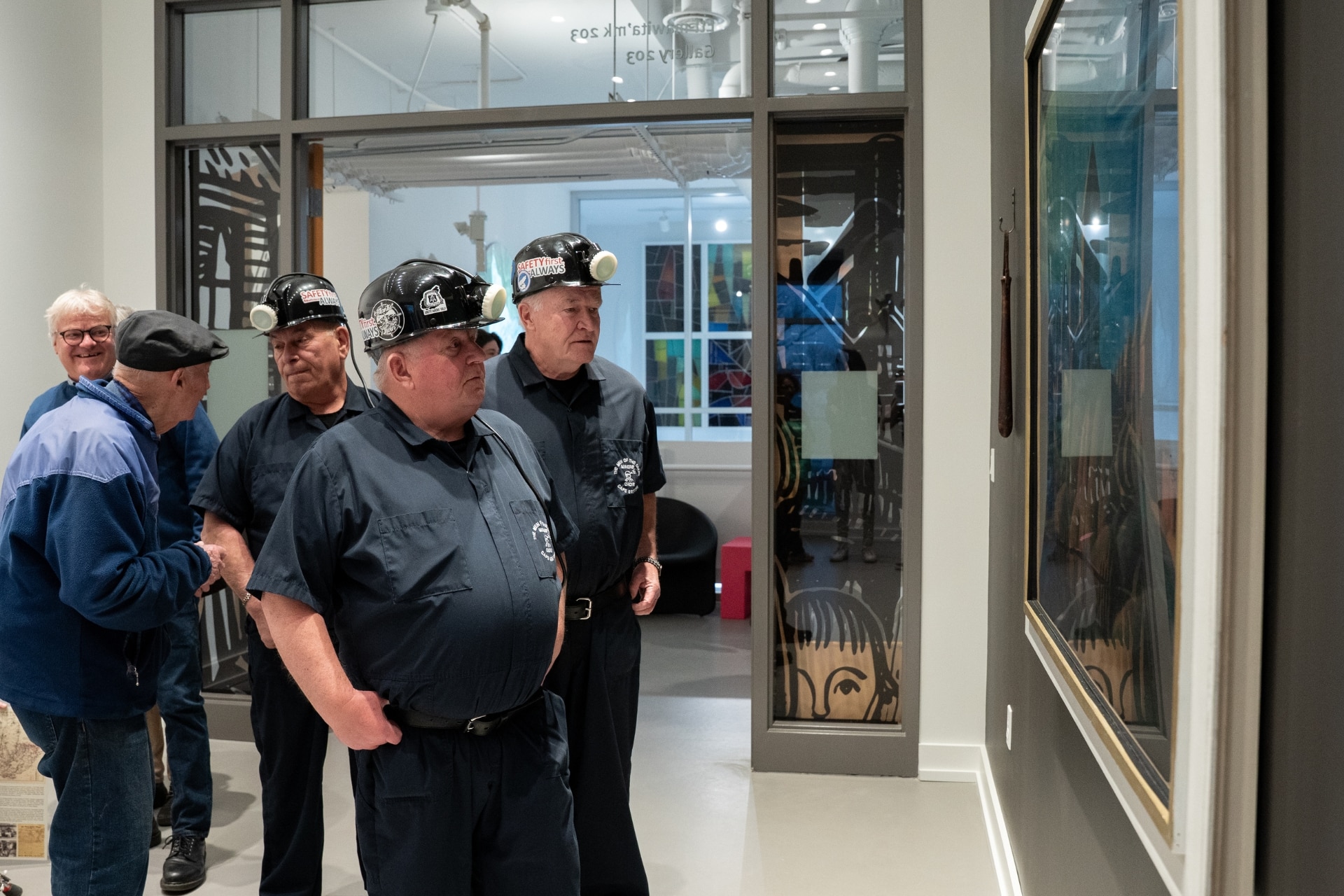
A 100-year-old painting by Group of Seven artist Lawren Harris is on exhibition now in Sydney, N.S., just in time for the anniversary of the event that led to the killing of coal miner William Davis.
The famous painting is called Miners’ Houses, Glace Bay and the exhibition’s official opening was May 2 at the Eltuek Arts Centre.
Melissa Kearney, the centre’s artistic director, told Information Morning Cape Breton she was awestruck when she first saw the piece at the Art Gallery of Ontario in 2016.
“[My] first instinct was everybody back home has to see this painting, because it so quite literally stops you in your tracks in its significance of this place and our history and the images, the symbolism, the icon of company houses and it being on the edge. Everything from the lighting to the homes themselves just screams Cape Breton Island.”
Miners’ Houses, Glace Bay is on loan from the Art Gallery of Ontario until June 28. It’s got its own exhibition space in the centre, which is a refurbished convent that dates back to 1885.
Kearney said the painting represents Harris’s final depiction of an urban industrial scene before his shift to northern landscapes.
Harris was in Cape Breton reporting for the Toronto Star newspaper during a lengthy coal miners’ strike in 1925 and was inspired to start the painting here, before returning to his studio in Toronto to finish it.
“In his career, [Harris] felt so bent and moved by what he saw that I think that was a breaking point for him as an artist and so [it is an] extremely significant painting for Canadians and especially for us,” Kearney said.
After Harris left but before the strike was over, miner William Davis was shot and killed by mining company police. The event is recognized across the province every June 11 as William Davis Miners’ Memorial Day.
Kearney, whose grandfathers and great-grandfathers were miners, said the painting evokes a number of themes. She said the houses can, at first glance, appear to be gravestones on the edge of a cliff, a sight that’s not uncommon on Cape Breton Island.
She said it’s also reminiscent of the old coal mining life. The painting is devoid of people, but Kearney said she assumes they are all working, either in the homes or in the mines underground.
Kevin Edwards, a member of the Men of the Deeps coal miners’ choir and a former miner himself, saw the painting for the first time at the opening and said he was amazed.
He said one of the choir’s goals is to maintain the history and culture of those who worked underground — the life-and-death struggles of the industrial way of life — and the painting serves a similar purpose.
“For me, it has a very eerie, subtle feel to it, knowing the background and the history of it. It means so much not only to the coal mining industry, but to the labour movement and basically human rights,” Edwards said.
“That single event back in 1925, Bill Davis and others were injured or killed and maimed … and it meant so much, but they had the courage and the strength to go and to stand up against the police and the hired goons … and it’s very, very meaningful.”
Lachlan MacKinnon, a history professor at Cape Breton University, said the painting helps tell the story of the coal miners’ strike and Davis’s death and the impact on the labour movement.
“That was a really important moment in our island’s history, because of the way that local workers, local coal miners and their families came together to challenge the ways that they were being exploited by their employer at the time,” he said.
The painting may appear bleak to some, but it portrays much more and still resonates, even though the coal mines closed in 2001, MacKinnon said.
“In a sense, you see the kind of the starkness of the moment. It evokes that sense of poverty, of exploitation, of sort of living on the edge in a way, which certainly the coal communities in the 1920s were,” he said.
“On the other hand, I think that there’s something that evokes solidarity. The images of the houses, their similarities one with one another, the way that they’re crowded together and sort of the vibrant colours, I think evokes sort of a sense of togetherness, of drawing close and sort of resiliency, which I think resounds quite well in a place like Cape Breton, where those values and those ideas continued long after 1925 and indeed after the closure of the mines altogether.”
Source: CBC News
Tom Ayers has been a reporter and editor for 39 years. He has spent the last 21 covering Cape Breton and Nova Scotia stories. You can reach him at tom.ayers@cbc.ca.